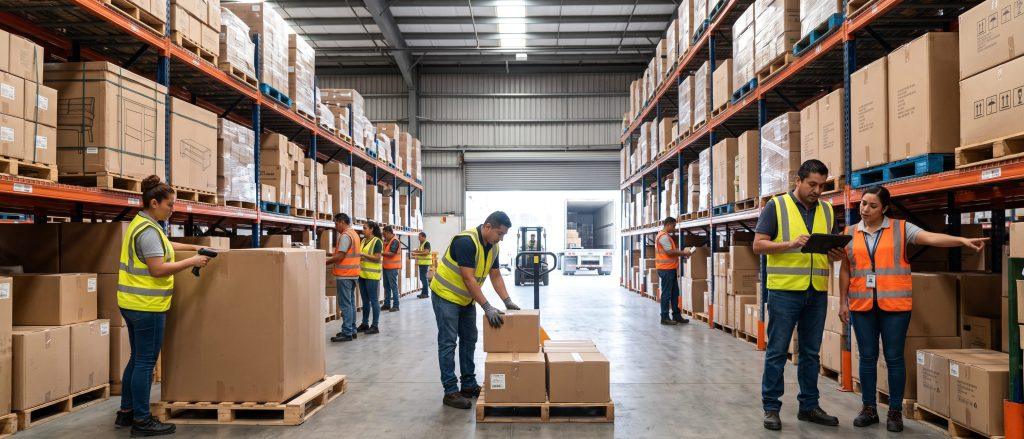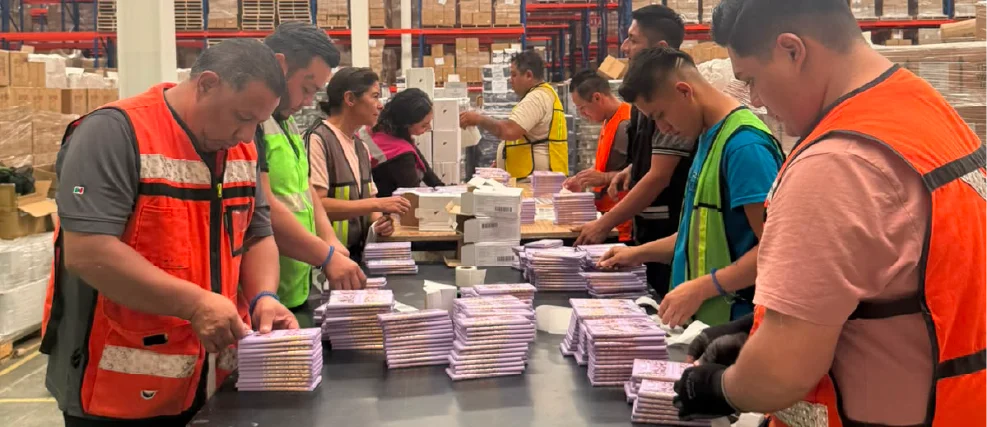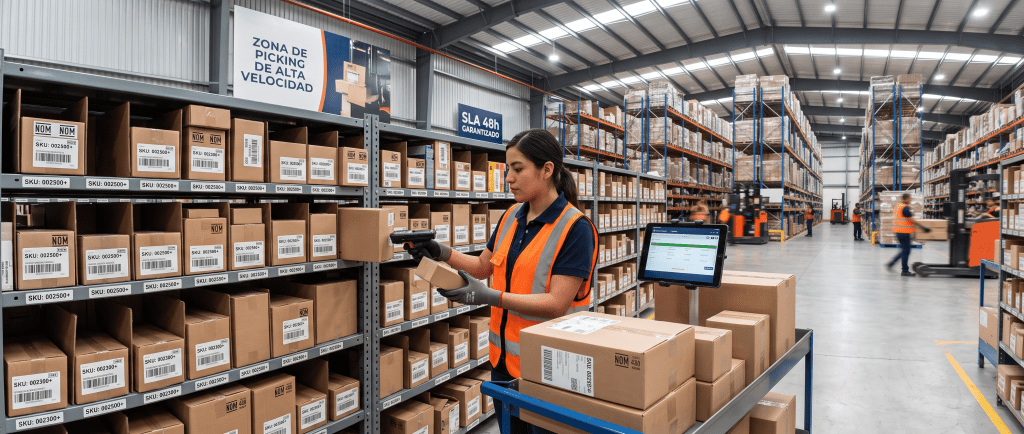


Picking is one of the most important operations in logistics and refers to the process of picking products from a warehouse to complete an order. It is a key activity in order picking, especially in ecommerce and retail businesses. Let's take a look at the functions of this logistics operation.
Picking functions in logistics
- Order preparation:
- Ensures that the right products are selected for each customer.
- This is the step prior to packing and shipping.
- Time optimization:
- Efficient picking reduces picking times, improving delivery speed.
- Error reduction:
- Ensures that products are harvested in the correct quantities and specifications.
- Customer satisfaction:
- By picking accurately and quickly, errors and delays are minimized, improving the customer experience.
- Logistics costs:
- By optimizing picking, costs associated with personnel and operating time are reduced.
What is the importance of picking in logistics?
With the rise of ecommerce, picking has become more strategic. Warehouses process hundreds or thousands of orders per day, so an inefficient picking system can lead to delays, errors and increased costs. That's why many companies are investing in automated systems, tracking technology and advanced techniques to optimize this task.
Picking Techniques: Advantages and Disadvantages
In logistics, picking techniques are the methods used to pick products from a warehouse and prepare them for shipment. These techniques vary according to volume, order frequency and warehouse layout. Here are the main ones:
| Single Order Picking (Single Order Picking) | - One operator picks all the products needed to complete a single order at a time. - Ideal for warehouses with low order volume. - Advantage: Simplicity. - Disadvantage: Not very efficient for high order volume. |
| Batch Picking (Batch Picking) | - The operator simultaneously picks products from several similar orders in a single round. - Advantage: Reduces travel time. - Disadvantage: Requires separation of products by order at the end. |
| Zone Picking | - The warehouse is divided into zones, and each operator is responsible for picking products only in his area. - Advantage: Optimizes operator specialization and reduces travel. - Disadvantage: Requires coordination between zones to complete orders. |
| Wave Picking (Wave Picking) | - Orders are grouped and products are picked in scheduled waves, according to schedules or priorities. - Advantage: Facilitates picking and shipping planning. - Disadvantage: More complex to manage. |
| Automated Picking | - Technology such as robots, automated conveyor systems or robotic arms are used. - Advantage: High precision and speed. - Disadvantage: High initial investment. |
| Combined Picking | - It combines several techniques according to the needs of the warehouse, such as picking by zone with batch picking. - Advantage: Flexibility and adaptation to different types of orders. - Disadvantage: Requires advanced management systems (WMS). |
You might be interested in:Learn | Import of Goods | NOM Labeling at Destination

Tips to improve picking
Optimization of warehouse design
- Organized warehouse: Place the most demanded products near the dispatch areas.
- ABC Rule: Organize products according to their rotation (A = high demand, B = medium, C = low).
Implementation of efficient picking techniques
- Batch picking: Picks products for several orders in a single round.
- Picking by zones: Divide the warehouse into sections and assign operators to each one.
- Wave Picking: Groups orders and schedules picks at specific intervals.
Staff training
- Trains operators in the use of technological systems and good harvesting practices.
- Perform simulations or training to improve accuracy and speed.
Automation
- Invest in robots and automated conveyors to reduce human effort and increase speed.
- Systems such as shuttle robots and mobile racking streamline the process.
- The choice of method depends on several factors, such as:
Minimization of travel
- Create efficient picking routes to reduce moving times.
- Use carts or motorized systems to transport products faster.
Data analysis and continuous improvement
- WMS Systems (Warehouse Management System)To optimize routes and coordinate operations.
- Pick-to-light or voice picking: Technologies that guide the operator to pick products faster.
- Intelligent carts or portable devices: To facilitate product identification and transportation.
At ABC Logistics we apply these techniques and optimize your picking to add value to your business.
Subscribe to our newsletter to receive logistics and marketing news that maximize your business!